Online shopping has changed how people discover, compare, and purchase products. From smartphones and fashion accessories to groceries and home app...



Online shopping has changed how people discover, compare, and purchase products. From smartphones and fashion accessories to groceries and home appliances, customers increasingly prefer the convenience of shopping through digital platforms. This shift has created opportunities for entrepreneurs who want to establish their own eCommerce businesses.
However, starting an online marketplace involves more than creating a website. Business owners need technology that supports multiple sellers, product management, secure payments, order processing, and a convenient shopping experience.
Developing all these functionalities from scratch can require significant time, technical expertise, and investment. This is why many entrepreneurs consider ready-made marketplace solutions.
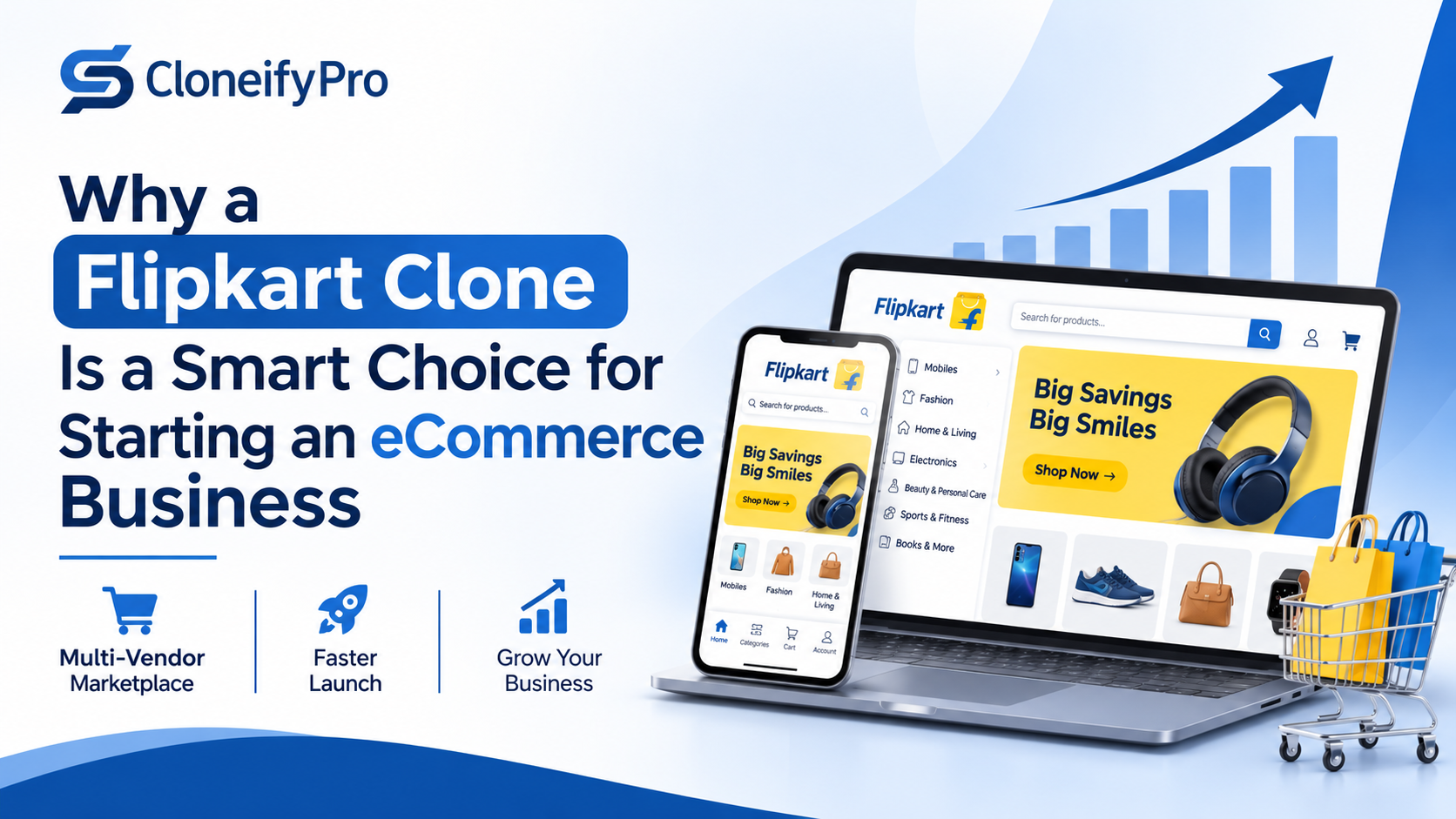
A Flipkart Clone offers a practical starting point for businesses interested in launching their own multi-vendor eCommerce marketplace. It provides a pre-developed foundation with essential functionalities that can be customized according to specific business requirements.
Let's explore why this solution can be a smart choice for entrepreneurs entering the eCommerce industry.
A Flipkart Clone is a ready-made eCommerce software solution designed to help entrepreneurs launch their own multi-vendor online shopping marketplace.
It allows multiple sellers to register, create stores, upload products, manage inventory, and receive orders through one centralized platform.
Customers can browse different product categories, compare products, add items to their carts, complete purchases, and track orders.
The marketplace administrator manages sellers, customers, products, transactions, and other activities through an administrative dashboard.
Depending on the business model, the platform can support categories such as:
Electronics and smartphones
Clothing and fashion accessories
Beauty and personal care products
Furniture and home appliances
Grocery and everyday essentials
Books and stationery
Unlike a single-seller online store, this model allows entrepreneurs to bring multiple vendors together and offer customers a wider product selection.
The increasing adoption of smartphones, digital payments, and online shopping has created new opportunities for businesses.
Here are three reasons why entrepreneurs are exploring this business model.
A physical store generally serves customers within a particular geographical area. An online marketplace can potentially reach customers across multiple cities and regions, depending on its delivery capabilities.
This creates opportunities to introduce products to a wider audience.
A multi-vendor marketplace brings different sellers together under one digital platform.
For example, customers can discover electronics from one vendor, fashion products from another, and home essentials from a third.
This provides more product choices while creating selling opportunities for participating vendors.
Entrepreneurs do not necessarily need to start with a general marketplace. They can focus on specific categories such as electronics, fashion, or grocery products and expand gradually.
This makes it easier to build a business around a particular audience and its requirements.
A ready-made marketplace solution can simplify the initial development process by providing a foundation for essential eCommerce functionalities.
Developing a marketplace from scratch involves designing interfaces, building seller and buyer functionalities, integrating payment systems, and testing different workflows.
A ready-made solution provides an existing foundation, reducing repeated development work and allowing entrepreneurs to focus on branding, business planning, and marketing.
The actual launch time depends on customization, integrations, testing, and deployment requirements.
Building every marketplace component independently can increase development expenses.
A pre-developed solution can reduce development effort by providing commonly required functionalities in an existing software package.
However, businesses should also consider customization, hosting, integrations, maintenance, and ongoing operational expenses when evaluating the overall investment.
One major advantage of a multi-vendor marketplace is the ability to onboard multiple sellers.
Vendors can manage their product listings, pricing, inventory, and orders through dedicated seller interfaces, while administrators maintain control over overall marketplace activities.
Your marketplace should have its own identity.
A customizable solution allows businesses to incorporate their logo, brand colors, banners, and supported design elements to create a recognizable shopping experience.
Features such as product search, category browsing, filters, shopping carts, checkout, and order tracking help customers navigate the marketplace more conveniently.
A smooth shopping experience can encourage customers to explore products and return for future purchases.
Choosing the right features is important because they determine how buyers, sellers, and administrators interact with your platform.
The buyer application should make discovering and purchasing products straightforward.
Important features include:
Product search and category browsing
Shopping cart and wishlist
Secure payment and checkout
Order tracking
Push notifications
These functionalities help customers browse products and manage their purchases conveniently.
A dedicated seller interface helps vendors manage their marketplace activities.
Essential functionalities include:
Seller registration and store management
Product listing and catalog management
Pricing and inventory control
Order processing
Sales monitoring
The admin dashboard provides centralized control over the marketplace.
Administrators can manage seller registrations, customer accounts, product categories, listings, orders, transactions, and marketplace settings.
It also helps monitor business activities and maintain marketplace guidelines.
Artificial intelligence is creating new possibilities for online shopping platforms.
Some useful AI capabilities include:
AI-Powered Chatbots: Assist customers with product questions, order information, and frequently asked questions.
Smart Pricing Insights: Analyze sales and inventory information to support pricing decisions.
AI-Based Fraud Detection: Help identify suspicious transactions and unusual account activities.
Automated Product Content: Assist sellers in creating initial product titles and descriptions.
Predictive Inventory Analytics: Use historical sales information to support stock planning.
Customer Insights: Analyze shopping patterns to improve product recommendations and marketing decisions.
These capabilities can support marketplace operations, although their availability depends on the software package and implementation.
A multi-vendor marketplace offers several potential revenue opportunities.
Collect a percentage or fixed fee from eligible transactions completed through your platform.
Offer monthly or annual packages with additional listings, enhanced visibility, or premium seller tools.
Allow vendors to pay for additional visibility through promoted product placements.
Generate revenue through relevant advertising placements without negatively affecting the shopping experience.
Introduce additional paid services such as seller analytics, promotional campaigns, and enhanced business accounts.
Choose a revenue model that suits your audience and operating expenses. Additional monetization methods can be introduced as your marketplace develops.
Launching a marketplace requires proper planning and a clear understanding of your target audience.
Follow these important steps:
Step 1: Identify Your Target Market
Decide whether you want a general shopping marketplace or a platform focused on specific product categories. Research customer requirements and competitors.
Step 2: Define Your Business Model
Determine how sellers will operate, how customers will purchase products, and how your marketplace will generate revenue.
Step 3: Select the Right Technology
Evaluate marketplace solutions based on features, customization, security, scalability, integrations, and technical support.
Step 4: Customize Your Platform
Configure your branding, storefront, categories, payment methods, and other functionalities.
Step 5: Onboard Sellers
Attract suitable vendors and establish clear guidelines for product listings, inventory, and order processing.
Step 6: Test Before Launching
Check registration, product discovery, checkout, payments, notifications, and order management before making the platform publicly available.
Step 7: Promote Your Marketplace
Use SEO, social media, digital advertising, email marketing, and seller partnerships to attract your initial customers.
Selecting the right technology provider can make the marketplace development process more manageable.
CloneifyPro offers a ready-made Flipkart Clone solution designed to help entrepreneurs, startups, and businesses establish their own branded multi-vendor eCommerce platforms.
The solution includes dedicated buyer, seller, and admin interfaces to support different marketplace activities.
Some highlighted functionalities include:
Customizable storefront and branding
Buyer application with product search and filtering
Seller registration and product management
Centralized admin dashboard
Shopping cart and checkout
Payment gateway integrations
Order and inventory management
Push notifications
AI-powered chatbot and shopping assistance
AI-assisted product content generation
Predictive inventory and customer insights
CloneifyPro also highlights customization options, deployment assistance, and marketplace management capabilities.
Businesses can explore the solution and request a demonstration to understand how it fits their requirements.
Explore CloneifyPro's Flipkart Clone and Start Building Your Own eCommerce Marketplace
Before purchasing, confirm the package inclusions, licensing terms, customization options, supported integrations, deployment requirements, and ongoing technical support.
Starting an eCommerce business requires careful planning, suitable technology, and a clear understanding of customer expectations.
A multi-vendor business model allows entrepreneurs to connect different sellers and product categories through one digital platform. However, long-term success also depends on seller relationships, product quality, customer service, payment reliability, delivery operations, and effective marketing.
A Flipkart Clone can provide a practical technological foundation for entrepreneurs who want to establish their own online shopping marketplace without developing every common functionality from scratch.
By selecting suitable software, understanding your target market, and focusing on buyers' and sellers' needs, you can take a structured approach toward building your eCommerce business.
Start by identifying local retailers, wholesalers, and independent sellers who want to expand their online reach. Offer introductory benefits, simplified onboarding, and promotional opportunities to encourage registrations. You can also approach potential sellers through business networks and social media.
Establish a centralized return and refund policy explaining eligibility, timelines, and responsibilities. Provide accessible customer support and define whether sellers or administrators handle different stages of the process.
Introduce seller verification and product approval procedures. Establish guidelines for product descriptions, images, pricing, and prohibited items. Monitor customer reviews and investigate reported listings to maintain marketplace standards.
Requirements depend on your location and business model. Consider business registration, applicable taxes, consumer protection, data privacy, payment regulations, and seller agreements. Consult qualified legal and tax professionals before launching.
Provide convenient payment options, order tracking, customer support, and transparent buyer policies. Clearly communicate the benefits of completing purchases through your platform and establish appropriate seller agreements.
Monitor active sellers, registered buyers, monthly orders, average order value, conversion rate, repeat purchases, cancellation rates, and customer acquisition costs. Reviewing these metrics regularly helps identify opportunities to improve marketplace performance.