Starting an online business in the United States can be an exciting opportunity for entrepreneurs who want to turn a business idea into a digital p...



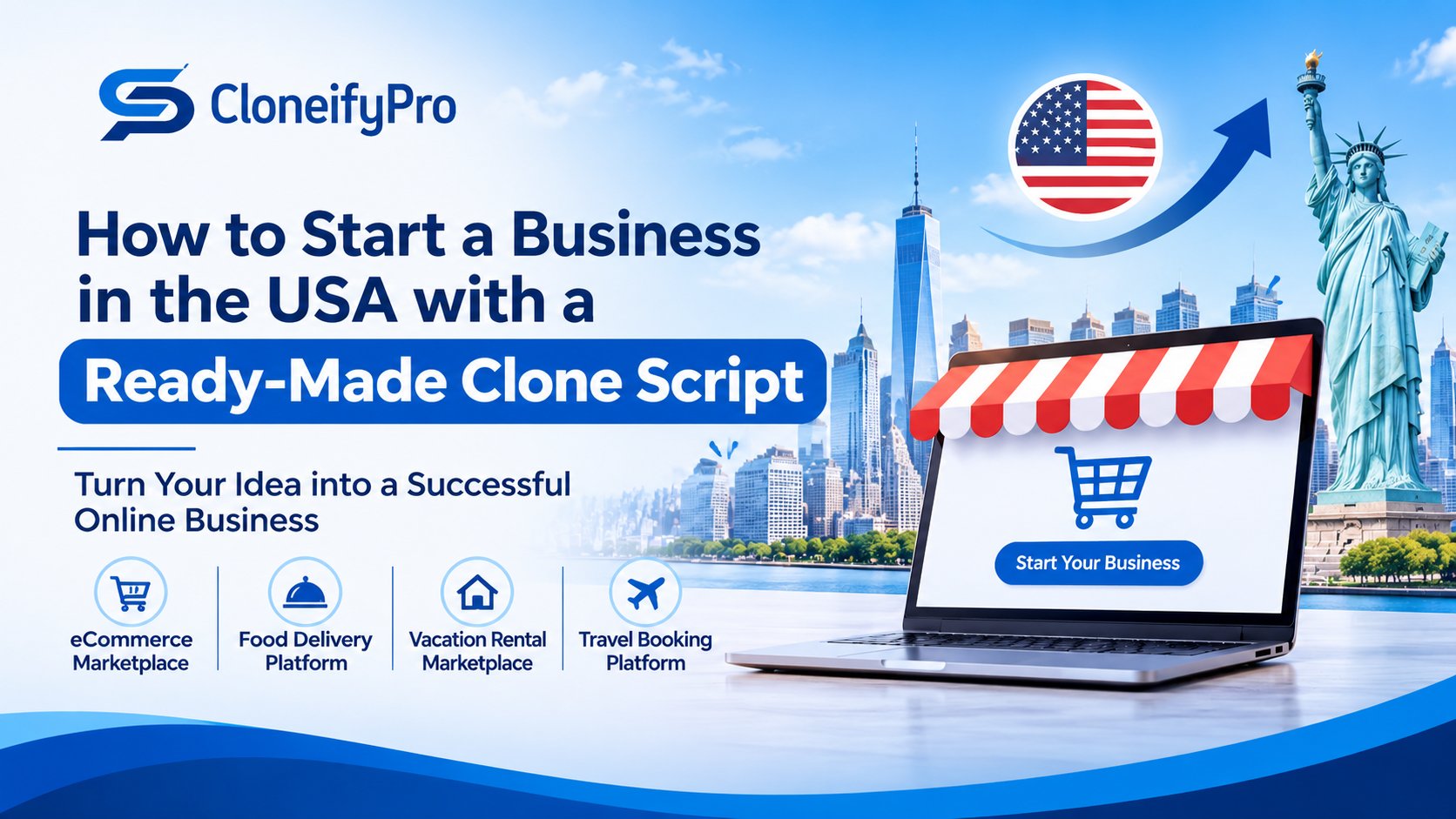
Starting an online business in the United States can be an exciting opportunity for entrepreneurs who want to turn a business idea into a digital platform. From eCommerce marketplaces and food delivery applications to vacation rental websites and travel booking portals, customers increasingly expect convenient online services.
However, turning an idea into a working platform involves more than choosing a business category. You need suitable software, a clear revenue model, a reliable operational process, and a strategy for reaching your target customers. Developing an application from scratch can also require significant time, technical resources, and investment.
A ready-made clone script offers an alternative approach. It provides a pre-developed software foundation based on an established digital business model. Entrepreneurs can use this foundation to create their own branded websites or applications and customize the functionality according to their requirements.
In this guide, we will explore how to start an online business in the USA using a ready-made clone script, which business opportunities you can consider, and how CloneifyPro's software solutions can help you take the next step.
The United States offers opportunities across several digital business industries. Consumers use online platforms to purchase products, order meals, book accommodation, arrange transportation, and access different services.
For entrepreneurs, these changing customer habits create opportunities to build platforms that solve specific problems.
Consider a few examples:
An entrepreneur can create an online marketplace connecting independent sellers with customers.
A startup can develop a food delivery platform that connects restaurants with local customers.
A property business can launch a vacation rental marketplace for hosts and travelers.
A travel agency can introduce an online portal where customers explore and reserve travel services.
A local business can build an on-demand service application connecting customers with service providers.
The key is to identify a specific audience rather than trying to compete with established platforms across every category. For example, a marketplace focused on independent fashion sellers in a particular US city may have a clearer starting point than a general shopping platform targeting the entire country.
A ready-made clone script is a pre-developed software solution based on an existing digital business model. It provides a starting point for creating a website or mobile application with functionality relevant to a particular industry.
Depending on the solution, it may include customer interfaces, administrative dashboards, seller or service-provider panels, booking workflows, payment integrations, and business management features.
For example, an entrepreneur planning to launch an eCommerce marketplace may choose software that supports product listings, shopping carts, seller management, and order processing.
The main advantage is that you do not have to develop every component from the beginning. You can start with an existing software foundation and focus on your branding, customization, business operations, and customer acquisition.
However, a clone script is not a ready-made business by itself. You still need to configure the platform, establish partnerships where necessary, attract customers, and manage daily activities.
Begin by deciding what type of online business you want to establish. Your choice should reflect customer demand, competition, available resources, and your understanding of the industry.
Here are some business categories worth exploring:
eCommerce Marketplace: Build a platform where multiple sellers can list products and customers can browse, compare, and purchase items.
Food Delivery Business: Connect restaurants, customers, and delivery partners through an online ordering platform.
Vacation Rental Marketplace: Allow property owners to list accommodation while travelers search and reserve suitable stays.
Travel Booking Business: Create a platform that helps customers explore travel services and make reservations.
Classified Marketplace: Develop a website where individuals and businesses can advertise products and connect with potential buyers.
Choose a business model that you can realistically operate. You do not need to launch with every possible feature or service. Starting with a focused offering can make it easier to understand your audience and improve your platform over time.
Once you have selected a business idea, research the customers you want to serve.
Understand their preferences, purchasing habits, common problems, and expectations from online platforms. You can also study competing businesses to identify how they present services, structure their pricing, manage transactions, and communicate with customers.
For example, if you want to launch a food delivery platform, examine how restaurants manage online orders and what customers expect from delivery tracking and customer support.
Pay attention to customer complaints and recurring service problems. These can reveal opportunities to differentiate your business.
You should also decide whether you want to serve a particular city, state, or customer segment initially. A clearly defined target market helps you develop more focused marketing campaigns and operational strategies.
After validating your business idea, select software that matches your requirements.
Different businesses need different functionality. An eCommerce marketplace requires product and inventory management, while a vacation rental platform needs property listings, availability calendars, and booking management.
When evaluating a ready-made clone script, consider these important factors:
Business-specific functionality: Does the software support your main business operations?
Customization options: Can you modify branding, design, and supported features?
Mobile compatibility: Can customers access the platform conveniently through smartphones?
Payment integration: Does it support payment providers suitable for your target market?
Administrative controls: Can your team manage customers, sellers, orders, and transactions?
Security: What security measures and maintenance arrangements are provided?
Technical assistance: Is support available during setup and after deployment?
Avoid selecting software simply because it advertises a large number of features. Focus on the functionality your business genuinely needs and confirm what is included in the selected package.
Your online platform should provide an experience that matches the expectations of your target audience.
Start by establishing a recognizable brand identity. Choose a business name, logo, colors, and website layout that communicate your services clearly.
For a US-focused business, consider configuring:
USD pricing and transparent fee information.
Payment methods supported by your selected payment provider.
Appropriate address, contact, and date formats.
Clear shipping, delivery, or booking information.
Customer support and refund procedures.
Mobile-friendly navigation and checkout processes.
If you plan to serve customers across different regions, consider whether additional language, currency, or location-based functionality is necessary.
A localized experience should reflect the actual requirements of your customers rather than simply changing the currency symbol.
A convenient payment process is important for any online business. Customers should be able to understand the total cost, complete transactions, and receive appropriate confirmations.
Choose a payment provider that supports your business location, transaction requirements, and intended customer markets.
Depending on your business model, you may also require integrations for:
Email and SMS notifications.
Shipping and delivery management.
Maps and location services.
Travel inventory or booking providers.
Customer relationship management.
Analytics and business reporting.
Remember that an advertised integration capability does not necessarily mean that a third-party service is automatically included. Confirm API access, account requirements, setup costs, commercial agreements, and transaction fees before purchasing your software.
Technology is only one part of establishing an online business. You also need a practical plan for managing customers, service providers, transactions, and daily operations.
Depending on your business structure, state, and industry, review applicable registration, taxation, licensing, consumer protection, privacy, and payment requirements. For example, businesses operating online marketplaces may need to consider seller verification and disclosure responsibilities.
Prepare clear policies covering:
Terms and conditions.
Privacy and customer data handling.
Refunds and cancellations.
Customer complaints and disputes.
Seller or service-provider responsibilities.
Payment and transaction procedures.
If you are unfamiliar with US business requirements, seek appropriate professional advice before launching.
Also, establish a customer support process. Customers should know how to contact your team when they experience a payment issue, booking problem, delayed order, or service-related concern.
Before launching publicly, test the complete customer journey.
Check registration, login, navigation, product or service listings, payments, notifications, and order or booking workflows. If your platform includes sellers or service providers, test their dashboards and onboarding processes too.
Consider beginning with a limited launch in a specific location or customer segment. This gives you an opportunity to collect feedback and identify operational issues before expanding.
To attract customers, use a combination of marketing strategies:
Search Engine Optimization: Create useful content targeting the products, services, and problems your audience searches for.
Paid Advertising: Run targeted campaigns to reach relevant customers in your selected locations.
Social Media Marketing: Share product updates, demonstrations, customer experiences, and promotional campaigns.
Business Partnerships: Collaborate with sellers, restaurants, property owners, or service providers who can help expand your reach.
Referral Marketing: Encourage satisfied customers to recommend your platform through suitable referral incentives.
Monitor website traffic, conversion rates, customer acquisition costs, completed transactions, repeat purchases, and customer feedback. These metrics can help you identify opportunities to improve the business.
Different entrepreneurs require different software solutions. CloneifyPro offers ready-made clone scripts and business software across several industries, giving startups options based on the type of platform they want to establish.
Here are some relevant solutions to explore.
If your business idea involves connecting multiple sellers with online shoppers, an eCommerce marketplace solution can provide a foundation for product listings, inventory management, shopping carts, order processing, and seller administration.
Explore the Flipkart Clone to understand how a multi-vendor marketplace can support buyers, sellers, and administrators through dedicated interfaces.
It can be a relevant option for entrepreneurs planning a branded online shopping platform with centralized marketplace management.
Food delivery businesses require functionality for restaurant listings, menu management, customer orders, delivery coordination, and payment processing.
CloneifyPro's DoorDash Clone Script is designed for entrepreneurs interested in building an online food delivery platform.
It provides a software foundation for customer ordering, restaurant management, order tracking, and related delivery workflows.
If you want to connect property owners with travelers, a vacation rental platform may be a suitable business model.
The Airbnb Clone Script offers functionality related to property listings, guest bookings, host management, search, availability, and reservation workflows.
It can be explored by entrepreneurs interested in creating a branded accommodation or short-term rental marketplace.
Travel entrepreneurs can build a platform where customers explore travel services and make reservations through a centralized booking experience.
Explore the Travel Booking Script for a solution designed for travel agencies, tour operators, and online travel portals.
Your business idea may require a different platform or more specialized development.
CloneifyPro's Clone Scripts Development page provides an overview of its software categories, including classified platforms, rental solutions, travel portals, food delivery applications, grocery delivery systems, and other business models.
You can also explore the CloneifyPro Feature Listing to review the range of business solutions available.
Before selecting a product, discuss your requirements with the team and confirm the included features, customization options, integration arrangements, deployment process, and support terms.
Selecting a software provider is an important decision because your platform will influence how your business operates and develops.
CloneifyPro offers ready-made clone scripts and software solutions for entrepreneurs exploring business opportunities across eCommerce, food delivery, travel booking, vacation rentals, classified marketplaces, and other industries.
Its solutions provide software foundations that can be evaluated and customized according to business requirements. Depending on the selected product and package, the available functionality and support arrangements may differ.
Before purchasing, clarify the following:
Which features are included in the selected package?
What branding and customization options are available?
Are third-party API integrations included or separately configured?
What are the hosting and deployment requirements?
What technical assistance is provided after delivery?
What is the expected delivery timeline for your requirements?
Visit CloneifyPro to explore the available software solutions and identify an option that aligns with your business idea.
Starting an online business in the USA requires more than a promising idea. You need to understand your target audience, identify a suitable business model, choose the right technology, and build an operational strategy that supports long-term growth.
A ready-made clone script can give you a practical starting point by providing an existing software foundation that can be customized for your business requirements. Whether you plan to launch an eCommerce marketplace, food delivery application, vacation rental platform, or travel booking website, selecting the right solution can help you move from planning to implementation more efficiently.
Before investing, take time to validate your business idea, estimate your operating costs, and understand the requirements of your target market. The US Small Business Administration's guide to starting a business is a useful resource for understanding important steps such as market research, business planning, funding, and registration.
If you are exploring software solutions for your business idea, CloneifyPro offers ready-made clone scripts across multiple industries. Explore the available solutions, compare their features, and discuss your requirements with the team to identify a platform that aligns with your goals.
Ultimately, a successful online business depends on the value it delivers to customers, not just the technology behind it. Start with a focused idea, build a convenient user experience, and improve your platform as your business grows.
It may be possible, depending on your business structure, location, activities, and applicable legal and tax requirements. Foreign founders should review business registration, ownership, tax obligations, banking access, and any relevant immigration considerations. Seek qualified professional advice before establishing operations.
Rather than competing with large platforms across every category, focus on a specific customer group, location, or service niche. Offer a clear value proposition, dependable customer support, transparent pricing, and a convenient user experience. Building trust within a focused market can help a new business develop its customer base.
Approach potential partners directly and explain the value your platform offers. You could provide introductory commission arrangements, promotional visibility, onboarding assistance, or early-partner benefits. Start with a manageable number of reliable providers so customers have useful choices from the beginning.
Prepare an operational plan before increasing marketing activity. Monitor order volume, provider capacity, customer support requests, and fulfillment performance. Establish procedures for delays, cancellations, and customer communication. You may also need additional staff, service providers, or technical resources as demand increases.
Start by checking business name availability, domain availability, and existing trademarks. Business name registration and trademark protection serve different purposes, so do not assume that registering a business automatically gives you nationwide trademark rights. Consider obtaining professional guidance before finalizing your brand identity.
Consider expansion when your existing market demonstrates consistent demand, manageable operating costs, reliable service quality, and repeat customers. Before entering another state, review local business registration, tax, licensing, insurance, and operational requirements. Expand based on business performance rather than traffic growth alone.