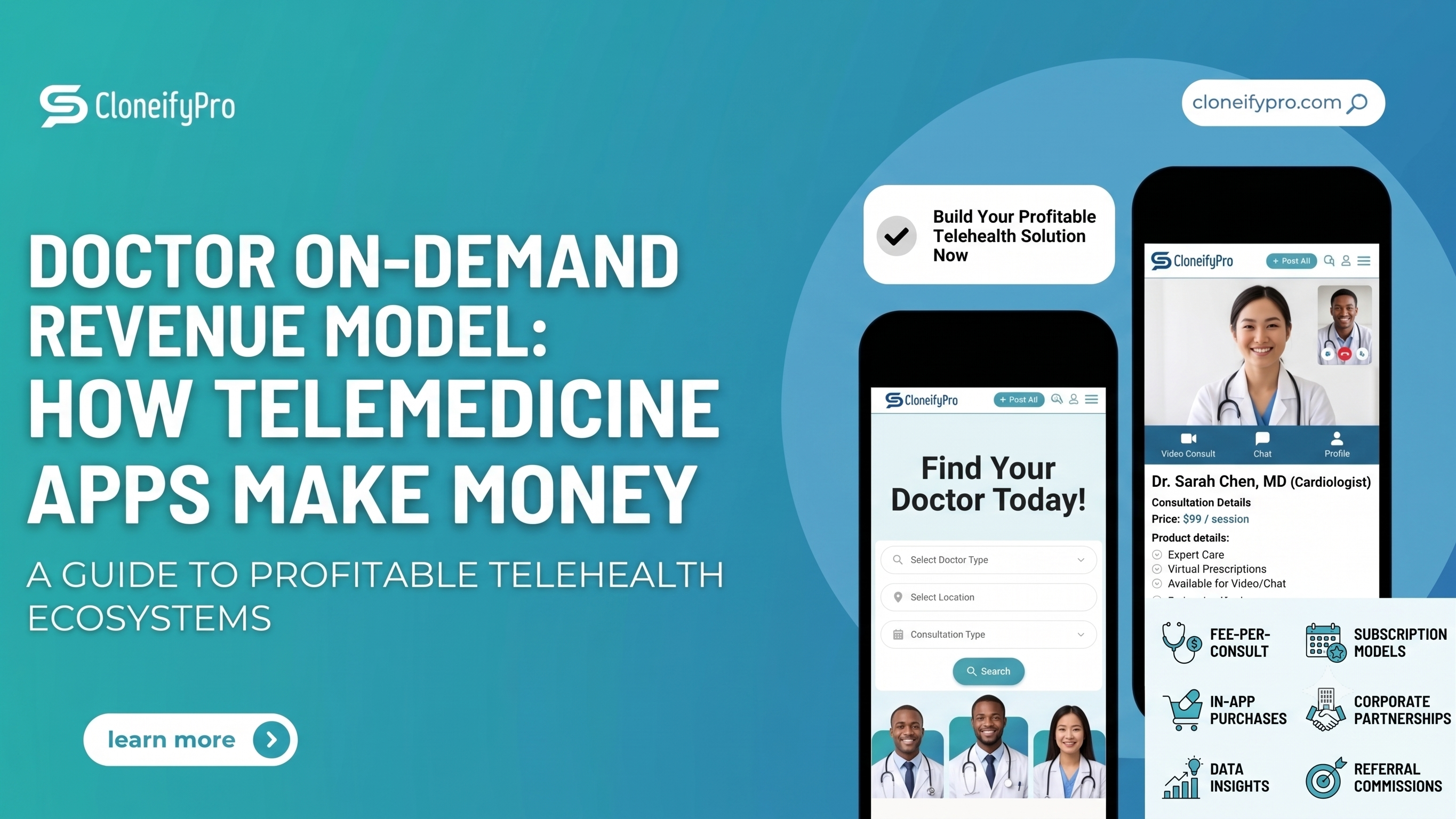
Telemedicine has changed the way patients access healthcare. Instead of traveling to a clinic for every consultation, patients can use a smartphone...



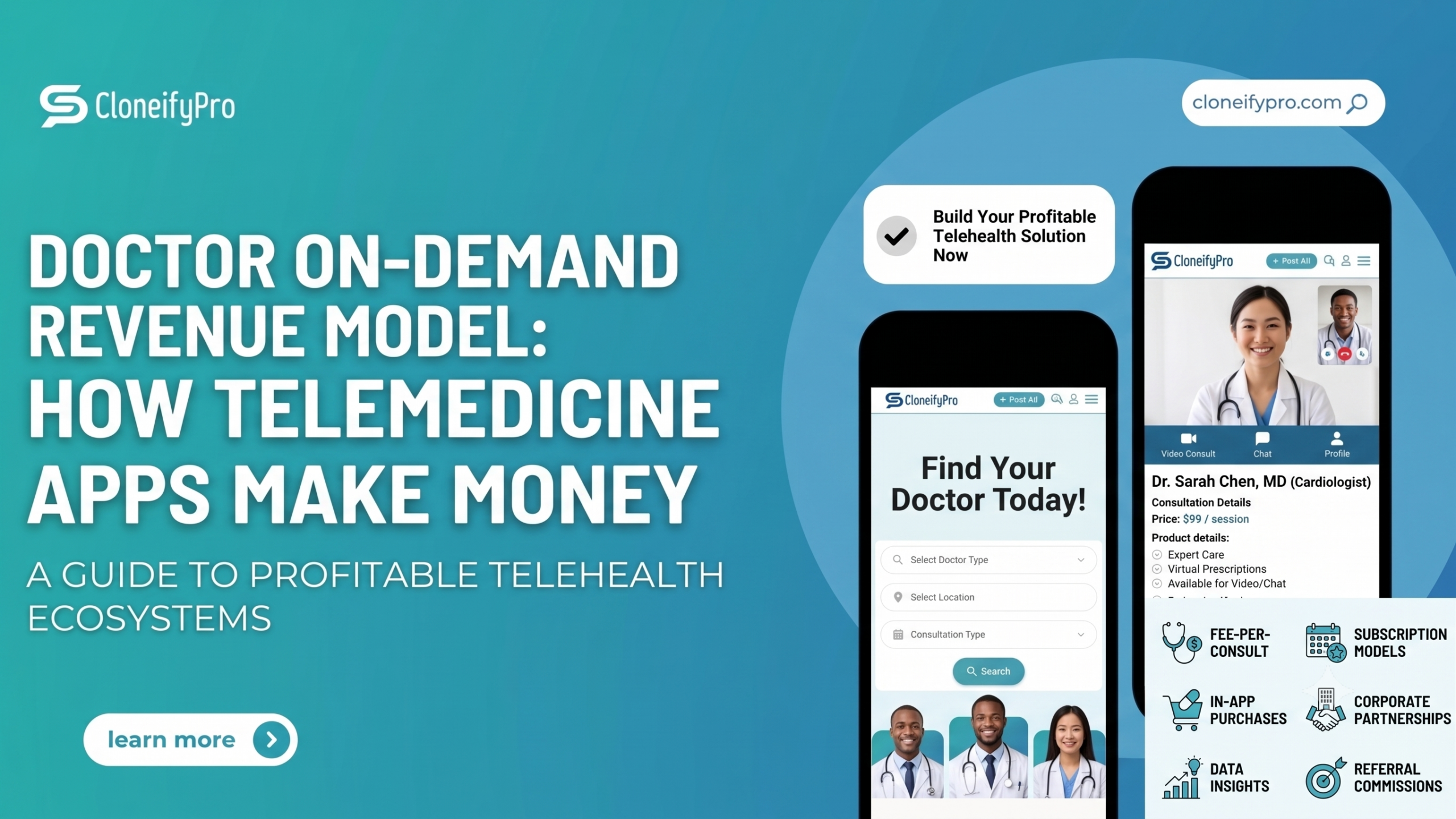
Telemedicine has changed the way patients access healthcare. Instead of traveling to a clinic for every consultation, patients can use a smartphone or computer to connect with healthcare professionals remotely. The World Health Organization (WHO) defines telemedicine as remote clinical care delivered through digital technologies, including synchronous and asynchronous services.
This shift has also created new opportunities for entrepreneurs, healthcare organizations, clinics, and technology companies. But building a telemedicine app is only one part of the business. The bigger question is: How does a Doctor On-Demand-style app make money?
The answer is usually a combination of consultation fees, subscriptions, healthcare partnerships, commissions, enterprise contracts, and additional digital health services.
In this guide, we explain the Doctor On-Demand revenue model, the major monetization strategies, important app features, and how a ready-made solution such as the CloneifyPro Doctor On-Demand app can help businesses enter the telemedicine market faster.
A doctor-on-demand-style platform connects patients with doctors, therapists, psychiatrists, or other qualified healthcare professionals through a digital platform.
The basic process is straightforward:
Doctor On Demand by Included Health currently offers both scheduled and immediate virtual care, while its pricing structure includes cash-pay consultations and coverage through health plans and employers.
This demonstrates an important point for entrepreneurs: telemedicine monetization does not have to depend on a single revenue stream.
The simplest monetization strategy is charging patients for individual consultations.
For example, a platform can charge different prices depending on:
Doctor On Demand currently uses a visit-based pricing structure rather than requiring a general membership fee. Its published cash-pay pricing includes $99 for a 15-minute urgent-care consultation, while psychology and psychiatry consultations have different rates.
For a startup, pay-per-consultation can be attractive because revenue is directly connected to platform usage.
Example:
If an app processes 1,000 paid consultations per month at an average platform-generated revenue of $20, monthly gross platform revenue would be $20,000 before provider payouts, payment processing, taxes, technology costs, and other expenses.
The actual economics depend heavily on geography, pricing, provider compensation, insurance arrangements, and operating costs.
Another common marketplace model is taking a commission from transactions generated through the platform.
Suppose:
The platform earns $7.50 from that consultation.
At scale, a large provider network can create recurring transaction revenue.
This model can be particularly useful when the platform brings healthcare professionals new patients, manages scheduling, payment collection, video consultations, notifications, and other administrative functions.
However, healthcare businesses should structure provider payments and commissions according to applicable laws, licensing requirements, payer rules, and local healthcare regulations.
A telemedicine business can also offer subscriptions.
Possible subscription packages include:
For example, a business might charge a monthly fee for access to selected virtual services while charging separately for certain specialist consultations.
Subscriptions can make revenue more predictable, but they should provide clear value to patients. A business should avoid creating a subscription merely for recurring billing.
B2B healthcare can become a significant revenue channel for telemedicine businesses.
Instead of acquiring every patient individually, a platform can work with:
Doctor On Demand states that it works with health plans and employers and that eligible members may receive covered virtual care.
For entrepreneurs, this creates an important opportunity: sell access to healthcare technology at the organizational level rather than relying only on individual consumers.
A B2B model could use per-member-per-month pricing, annual contracts, usage-based pricing, or customized enterprise agreements.
Insurance integration can create another pathway for monetization.
Instead of collecting the entire consultation fee directly from a patient, a telemedicine platform may work with insurers or health plans where the service is eligible for coverage.
The business model becomes more complex because reimbursement depends on the payer, location, healthcare service, provider credentials, contractual terms, and applicable regulations.
For this reason, entrepreneurs should treat insurance integration as a business and compliance project—not simply a payment gateway feature.
Once a telemedicine platform has an active user base, additional services can increase revenue opportunities.
These may include:
The WHO notes that telehealth can include services beyond direct virtual consultations, such as remote monitoring and other digital health activities.
The key is to add services that genuinely improve the patient journey rather than creating unnecessary upsells.
A successful telemedicine platform needs more than a video-call feature.
A typical Doctor On-Demand-style application can include:
Doctors may need:
The business owner can require:
CloneifyPro's Doctor On Demand solution specifically promotes features such as instant consultations, secure payments, appointment scheduling, patient management, e-prescription support, medical history, 24/7 availability, and AI-related capabilities.
Healthcare apps handle highly sensitive information. That makes privacy and security fundamental parts of the business model—not optional technical extras.
In the United States, HIPAA requirements can apply to covered healthcare providers and business associates using telehealth technologies. HHS recommends secure communications and appropriate safeguards for protected health information.
Important considerations include:
HHS also recommends conducting risk analysis and implementing appropriate privacy and security measures for telehealth platforms.
Importantly, HIPAA compliance is not automatically guaranteed simply because software is marketed as a telemedicine app. Businesses must evaluate their own workflows, vendors, data practices, contracts, and applicable laws.
For businesses operating outside the United States, other privacy and healthcare regulations may apply.
Building a telemedicine platform completely from scratch can require significant development time, product planning, testing, infrastructure, and ongoing maintenance.
A ready-made solution can reduce the initial product-development burden.
CloneifyPro offers a Doctor On Demand Clone designed for clinics, hospitals, doctors, and telehealth businesses. Its product page highlights appointment scheduling, virtual consultations, secure payments, patient management, medical history, e-prescription support, and other telemedicine functionality.
The advantage of a customizable clone solution is not simply launching quickly. The bigger benefit is starting with a defined product foundation and adapting it around your target market.
For example, an entrepreneur could build a platform focused specifically on:
Before launch, the business should validate its target market, provider network, pricing strategy, legal requirements, healthcare workflows, and data-protection obligations.
For a new telemedicine startup, a diversified model can be more sustainable than depending on one income source.
A possible strategy is:
Stage 1: Launch with pay-per-consultation.
Stage 2: Build a reliable network of healthcare professionals.
Stage 3: Introduce provider commissions or marketplace fees where legally appropriate.
Stage 4: Add premium patient packages or subscriptions.
Stage 5: Develop B2B employer and healthcare-provider partnerships.
Stage 6: