Finding a reliable babysitter has traditionally depended on personal recommendations, local networks, or last-minute phone calls. For busy parents ...



Finding a reliable babysitter has traditionally depended on personal recommendations, local networks, or last-minute phone calls. For busy parents and caregivers, that process can be stressful—especially when childcare is needed unexpectedly.
The rise of on-demand service platforms has introduced a different approach: use technology to make finding, booking, communicating with, and paying service providers easier.
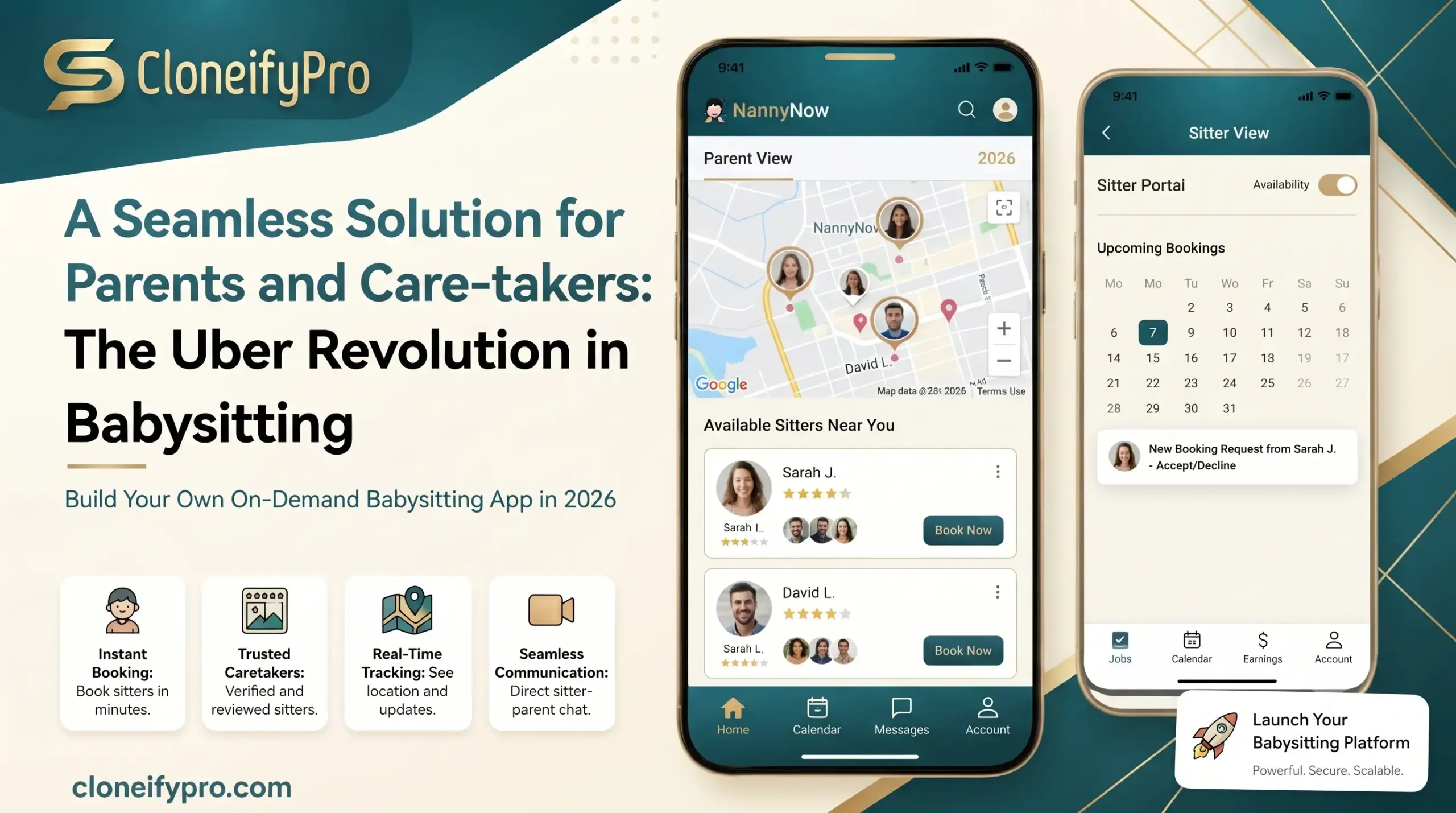
This concept has also entered the childcare industry through Uber babysitting app models, where parents can discover available babysitters, review profiles, request services, manage bookings, and make payments through a mobile platform.
However, childcare is fundamentally different from ordering food or booking a ride. Parents are trusting another person with their children. Therefore, a successful babysitting marketplace must combine on-demand convenience with strong safety, screening, communication, and trust mechanisms.
This article explores how an Uber-inspired babysitting platform can work and what entrepreneurs should consider when building one.
An uberbabysitting app is an on-demand childcare marketplace that connects parents or guardians with babysitters and caregivers through a digital platform.
The basic concept is straightforward:
Parent requests childcare ? Platform finds suitable sitters ? Parent reviews the match ? Booking is confirmed ? Babysitter provides care ? Payment and feedback are completed
The business model takes inspiration from the convenience of on-demand marketplaces while adapting the experience to the specific requirements of childcare.
Existing childcare marketplace projects have demonstrated the potential of this model. For example, Hello Sitter was designed as an on-demand childcare marketplace connecting parents and babysitters, with features including sitter selection, availability, payments, and search functionality.
The important distinction is that an Uber-inspired babysitting platform should not simply copy Uber's product. It should adapt marketplace technology to the much higher trust and safety requirements of childcare.
Modern families often have schedules that don't fit neatly into traditional childcare arrangements.
Parents may need childcare for:
A digital marketplace can make the search process more structured.
Instead of contacting multiple people individually, parents could potentially search available caregivers, compare profiles, review qualifications, check availability, and request a booking from one application.
That convenience is one of the key ideas behind the Uber for Babysitting app concept.
A well-designed platform can divide the experience into several stages.
Parents create an account and provide relevant information such as:
For recurring bookings, parents may also save preferences to simplify future requests.
Caregivers can create profiles containing information such as:
For a childcare marketplace, profile information should be meaningful enough for parents to make informed decisions.
This is one of the most important components of a babysitting platform.
Depending on the market and applicable laws, the platform may need processes for:
The exact requirements vary by jurisdiction and business model.
Research into on-demand babysitting platforms has repeatedly highlighted screening and due diligence as critical considerations. ABC News, for example, reported expert guidance recommending that parents investigate screening processes, references, and relevant childcare checks when using online babysitting marketplaces.
Convenience should never replace childcare safety.
Parents can enter their requirements and receive suitable babysitter recommendations.
A matching system could consider:
Over time, machine learning could potentially improve recommendations based on booking history and user preferences.
Once a parent selects a suitable caregiver, they can request a booking.
The system can support:
This gives both parents and caregivers a clearer view of their commitments.
Communication is essential before and during childcare appointments.
An app can provide secure messaging so parents and babysitters can discuss:
The platform should be designed to protect personal information and provide appropriate communication controls.
A digital payment system can make transactions simpler for both sides.
Possible capabilities include:
For marketplace businesses, payment architecture should also account for how funds are collected and distributed between the platform and caregivers.
After a completed booking, parents can provide feedback about their experience.
Ratings can help future users evaluate caregivers, while feedback can help the marketplace identify quality issues.
However, ratings should be treated as one signal rather than proof of safety or suitability. A strong platform should combine reviews with verification, qualifications, policies, and other trust mechanisms.
If you're planning to develop an uber for babysitting app consider dividing features according to the platform's primary users.
Key features can include:
Caregivers may need:
The administrator should have tools for managing the marketplace.
Important functionality may include:
This is where an Uber-inspired babysitting platform differs substantially from a typical on-demand marketplace.
Parents aren't simply hiring someone to deliver an item. They're entrusting another person with their children.
Therefore, platform owners should carefully consider:
Establish reliable processes for confirming the identity of caregivers.
Where legally and operationally appropriate, screening can help identify relevant criminal-history or safeguarding concerns.
If caregivers claim childcare, first-aid, CPR, or other qualifications, the platform should have a method for verifying applicable credentials.
Keep sensitive contact information protected and provide appropriate in-app communication tools.
Parents and caregivers should have clear processes for reporting emergencies or serious incidents.
Parents may need to securely provide important information about allergies, medications, routines, authorized pickups, or other care instructions.
The platform should clearly explain its screening process, cancellation policies, dispute procedures, privacy practices, and responsibilities.
Uber itself demonstrates how safety can be integrated into an on-demand platform through tools such as identity and driver screening, GPS tracking, emergency assistance, incident support, and trusted contacts.
A babysitting marketplace should adapt this principle to childcare rather than assume transportation safety features automatically transfer to childcare.
The primary benefit is convenience with structure.
Instead of relying exclusively on informal recommendations, parents can potentially use one platform to:
Uber's Family Profiles demonstrate how digital platforms can support family-oriented account management, including multiple linked users and shared payment arrangements.
For a dedicated babysitting marketplace, similar family-oriented concepts could be adapted around childcare rather than transportation.
The marketplace can also create value for caregivers.
Babysitters can potentially use the app to:
This creates a two-sided marketplace where the platform must balance the needs of both parents and caregivers.
There are several ways an entrepreneur can monetize an uberbabysitting app.
The platform takes a percentage of each completed booking.
A small platform fee can be charged to parents, caregivers, or both parties.
Parents could receive premium benefits through a monthly or annual membership.
Qualified caregivers may pay for additional visibility, subject to appropriate marketplace policies.
Childcare agencies or professional caregivers could potentially receive enhanced management tools through paid plans.
The right model depends on local regulations, customer expectations, acquisition costs, and marketplace economics.
Entrepreneurs generally have two approaches.
Custom development offers maximum flexibility.
You can create:
The downside is that development can require more time, resources, testing, and ongoing maintenance.
A ready-made solution can provide a starting point with common marketplace functionality already developed.
This may allow entrepreneurs to focus more resources on:
When evaluating a ready-made solution, don't focus only on the number of features. Ask about source-code access, customization, security, scalability, third-party integrations, updates, documentation, and support.
Technology alone won't make a childcare marketplace successful.
The strongest platforms need to build trust on both sides of the marketplace.
Consider focusing on these areas:
Parents need confidence in the people they hire.
The booking experience should be fast without sacrificing important safety checks.
The marketplace should maintain standards for caregiver onboarding and service quality.
Fees, policies, verification status, and responsibilities should be easy to understand.
Caregivers should honor confirmed bookings, while parents should understand cancellation and payment policies.
Childcare regulations can vary significantly between countries, states, and cities. Legal and regulatory requirements should be reviewed before launching.
The broader on-demand economy has demonstrated that technology can make fragmented services easier to discover and manage.
But childcare requires a different mindset.
The future of the uberbabysitting app is likely to involve more sophisticated matching, better verification workflows, family profiles, scheduling automation, digital payments, and personalized recommendations.
AI could also support administrative tasks such as matching caregivers with suitable requests, identifying scheduling conflicts, assisting customer support, and personalizing search results.
However, AI should support—not replace—human judgment in safety-critical childcare decisions.
.
The uberbabysitting app concept combines the convenience of an on-demand marketplace with one of the most trust-sensitive services a family can purchase.
That combination creates a significant product opportunity—but also a significant responsibility.
The winning platform won't simply be the one that matches a parent with the nearest available sitter. It will be the one that creates a reliable ecosystem where parents can make informed choices, caregivers can build trusted professional profiles, and everyone understands how bookings, payments, communication, and safety procedures work.
For entrepreneurs entering this market, the best starting point is to define the target audience, understand local childcare requirements, establish strong trust and safety processes, select the right technology approach, and build an experience around the real needs of parents and caregivers.
An Uber-inspired model can provide the convenience framework. The childcare business must provide the trust framework.
FAQ