The relocation industry is rapidly moving toward digital-first services. Customers no longer want to spend hours calling multiple moving companies,...



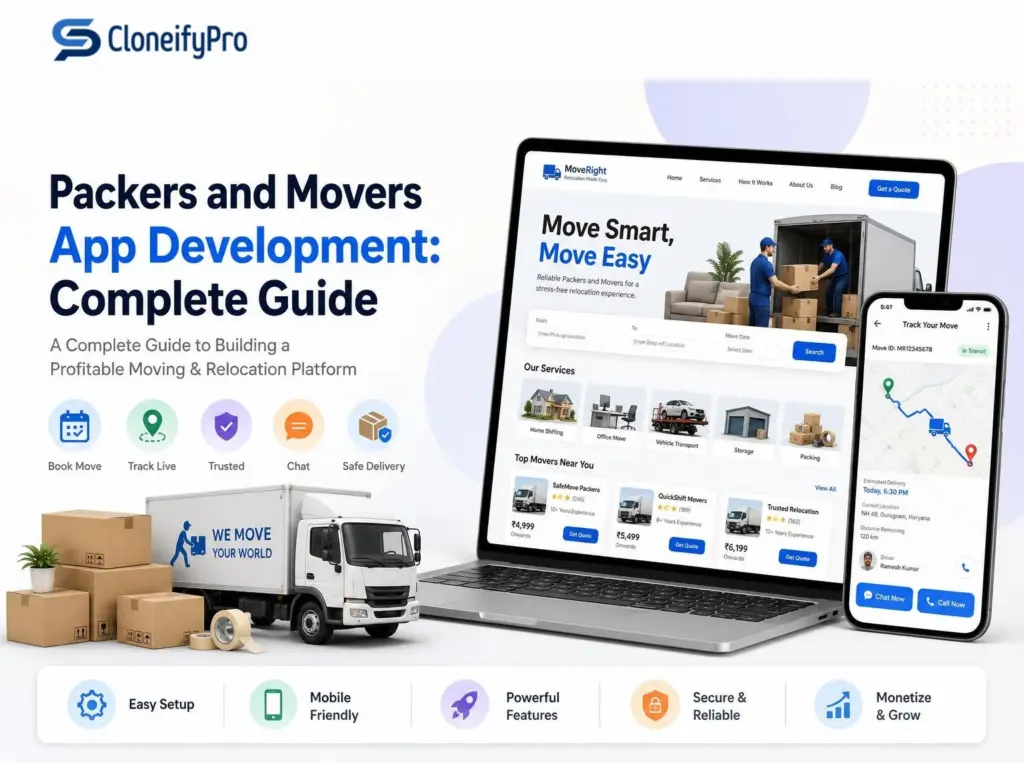
The relocation industry is rapidly moving toward digital-first services. Customers no longer want to spend hours calling multiple moving companies, comparing prices manually, or waiting for updates about their belongings. A packers and movers app can bring customers, moving companies, drivers, and administrators together on a single platform, making the entire relocation process faster and more transparent.
For entrepreneurs, this creates a strong opportunity to launch an on-demand moving and logistics marketplace. Similar to how taxi app development transformed traditional transportation services, packers and movers app development can modernize the relocation industry through online booking, real-time tracking, digital payments, automated notifications, and intelligent management tools.
If you are planning to launch your own moving app, this guide explains the essential features, development process, business models, technology requirements, costs, and benefits of choosing a ready-made solution such as CloneifyPro.
Packers and movers app development involves creating a mobile or web-based platform that allows customers to book relocation services digitally. Depending on the business model, users can request household shifting, office relocation, vehicle transportation, packing services, loading and unloading, storage, or other logistics solutions.
A complete platform generally includes three major components:
This structure is comparable to the architecture used in successful on-demand platforms, including applications developed through models similar to taxi app development.
The traditional relocation process often involves fragmented communication, uncertain pricing, limited tracking, and inconsistent service quality. A dedicated app can address many of these challenges.
Urbanization, job transfers, education, business expansion, and lifestyle changes continue to create demand for moving services. Customers increasingly expect the convenience of booking these services online.
Users can compare services, request estimates, schedule moving dates, and communicate with providers without visiting an office or making numerous phone calls.
GPS-based tracking allows customers to monitor the movement of their belongings or assigned vehicle. This improves transparency and reduces uncertainty.
Instead of managing every booking manually, businesses can automate assignments, notifications, invoices, payment confirmations, and status updates.
A packers and movers platform can generate revenue through commissions, service charges, subscriptions, advertisements, premium listings, storage services, and other value-added offerings.
A successful app needs more than a basic booking system. It should provide useful features for every participant in the ecosystem.
User Registration and Login: Customers should be able to create accounts using email, phone numbers, or social login options.
Service Selection: Users can select household shifting, office relocation, vehicle transportation, packing-only services, storage, or other available services.
Instant Quote: Customers can enter pickup and destination details, property size, inventory information, and preferred service dates to receive an estimated price.
Booking Management: Users should be able to create, modify, cancel, and view current or previous bookings.
GPS Tracking: Customers can track the assigned vehicle or moving team in real time.
Multiple Payment Options: Integration with digital wallets, cards, bank transfers, and other payment gateways can make transactions more convenient.
Push Notifications: Automated notifications can inform customers about booking confirmation, mover assignment, pickup arrival, payment status, and delivery completion.
Ratings and Reviews: Customers can rate movers and provide feedback after completing a relocation.
The service-provider application is equally important.
Providers should be able to:
These features are similar in concept to driver-side functionality commonly implemented in taxi app development, although the workflows are adapted for relocation and logistics services.
The admin dashboard gives business owners centralized control over the platform.
Important functions include:
An advanced dashboard can also provide insights into booking volumes, revenue, customer acquisition, provider performance, and popular service locations.
To differentiate your platform from competitors, you can introduce advanced technologies and features.
AI and data analytics can analyze distance, inventory, property size, labor requirements, vehicle type, seasonality, and other factors to generate more accurate estimates.
Customers can create a digital inventory of furniture, appliances, boxes, and other belongings. This information can help movers prepare the right workforce and vehicle.
Customers and service providers can communicate directly through secure in-app messaging.
Identity and business verification can help establish trust between customers and moving companies.
Intelligent route planning can help drivers reduce unnecessary travel time and fuel consumption.
Entrepreneurs can expand their operations across multiple cities and regions from the same platform.
The basic workflow is straightforward:
Automation throughout this process helps reduce administrative work while improving the customer experience.
Before development, entrepreneurs should select a suitable revenue model.
The platform charges a percentage of every completed booking.
Moving companies pay a recurring fee to access premium platform features or receive customer leads.
Providers pay for qualified customer leads generated through the platform.
Movers can pay to receive greater visibility within search results.
The platform can generate additional revenue through relevant advertisements and promotional placements. A hybrid model combining commissions, subscriptions, and premium listings can create multiple revenue streams
A structured development process helps reduce delays and unnecessary expenses.
Identify your target customers, competitors, service categories, operating regions, and pricing strategy.
Start with essential features such as registration, service selection, booking, quotation, provider assignment, tracking, payments, and notifications.
Create simple interfaces that allow customers and movers to complete tasks with minimal steps.
Develop the customer application, provider application, backend infrastructure, database, APIs, payment integrations, maps, and admin panel.
Test the application for functionality, security, performance, compatibility, payment processing, GPS accuracy, and usability.
Deploy the application to the relevant app stores and launch your initial service region.
Use customer feedback and analytics to introduce new services, improve workflows, and expand into additional markets.
The cost depends on factors such as:
Building a completely custom platform from scratch can require substantial time and resources. Businesses that want to enter the market faster can consider a ready-made or customizable solution.
CloneifyPro provides a practical approach for entrepreneurs who want to launch an on-demand service platform without building every component from the ground up.
A ready-made solution can help businesses reduce development time while providing a foundation for customization. Entrepreneurs can adapt branding, features, workflows, service categories, pricing structures, and other elements according to their business model.
For startups entering the relocation industry, this approach can be particularly useful because it allows them to focus more on customer acquisition, partnerships, service quality, and market expansion rather than spending months developing basic platform infrastructure. CloneifyPro can also be positioned as a solution for entrepreneurs exploring multiple on-demand business models. Businesses familiar with taxi app development, delivery applications, logistics platforms, and other marketplace concepts can leverage similar technological principles when building a modern packers and movers platform.
A clone-based application does not necessarily mean launching an identical copy of another brand. Instead, it can provide a proven foundation containing common marketplace functionality that can then be customized for your specific business.
Key advantages include:
This can make a clone solution attractive for entrepreneurs who want to validate their business idea before investing heavily in a fully custom platform.
The relocation industry presents significant opportunities for businesses willing to embrace digital transformation. A well-designed packers and movers app can simplify bookings, improve communication, provide real-time visibility, automate operations, and create new revenue opportunities.
The evolution is similar to what happened with taxi app development: traditional services became more accessible when technology connected customers and service providers through a single platform.
If you are planning to launch a relocation marketplace, choosing the right development strategy is critical. Instead of starting everything from zero, a customizable solution from CloneifyPro can provide the foundation needed to launch faster and focus on growing your business.
From customer bookings and mover management to GPS tracking, payments, notifications, and administration, the right platform can turn a conventional packers and movers business into a scalable on-demand digital marketplace.
Ready to launch your own packers and movers app? Explore CloneifyPro and build a feature-rich relocation platform designed around your business goals.
A Packers and Movers app is an on-demand mobile platform that connects customers with moving and relocation service providers. Customers can book services, receive quotations, schedule pickups, track vehicles, make payments, and review movers through the app.
CloneifyPro provides a ready-made and customizable solution for launching a Packers and Movers platform. Businesses can customize the app’s branding, features, pricing, workflows, and service categories according to their requirements.
Yes. The platform can be customized to match your business model and brand identity. You can modify the user interface, services, pricing structure, commission model, and other functionality based on your operational needs.
A complete solution can include separate interfaces for customers and movers or drivers, along with an admin panel. This allows customers to book services, providers to manage jobs, and administrators to control the overall platform.
Yes. GPS and map integration can enable customers to track assigned vehicles and monitor the progress of their relocation service in real time.
Yes. Payment gateway integration can allow customers to make secure digital payments through supported payment methods. The available options can be configured according to your target market and business requirements.
Yes. A scalable Packers and Movers platform can support operations across multiple cities and locations. This makes it easier to expand your business after establishing your initial market.
You can monetize the platform through booking commissions, service fees, provider subscriptions, premium listings, lead-generation charges, advertisements, and other value-added services.
Both platforms use several similar on-demand technologies, including GPS tracking, booking management, provider assignment, digital payments, notifications, ratings, and admin management. However, Packers and Movers applications require additional logistics and relocation-specific workflows.
A ready-made solution can help reduce development time and initial costs while providing core functionality that can be customized. With CloneifyPro, entrepreneurs can focus on launching, acquiring customers, partnering with movers, and expanding their business instead of developing every basic feature from the ground up.