Building a hotel comparison platform can be an attractive opportunity in the travel-tech market. Travelers increasingly want to compare hotel price...



Building a hotel comparison platform can be an attractive opportunity in the travel-tech market. Travelers increasingly want to compare hotel prices, reviews, amenities, locations, and booking options before deciding where to stay. Instead of visiting multiple booking websites separately, a hotel metasearch platform brings those options together in one place.
A Trivago-style clone script is designed around this same core concept: compare accommodation offers from multiple suppliers and help travelers identify a suitable deal.
Trivago itself describes its service as a metasearch engine rather than a traditional online travel agency (OTA). It compares accommodation offers from booking sites, hotel chains, and independent properties, then sends users to the relevant booking site to complete the reservation.
This distinction is important for anyone planning to launch a Trivago-like business.
A Trivago script is a ready-made or customizable software solution that can be used to create a hotel metasearch website or mobile application.
Instead of developing every component from scratch, a business can start with an existing software foundation and customize it according to its target audience, location, suppliers, branding, and business model.
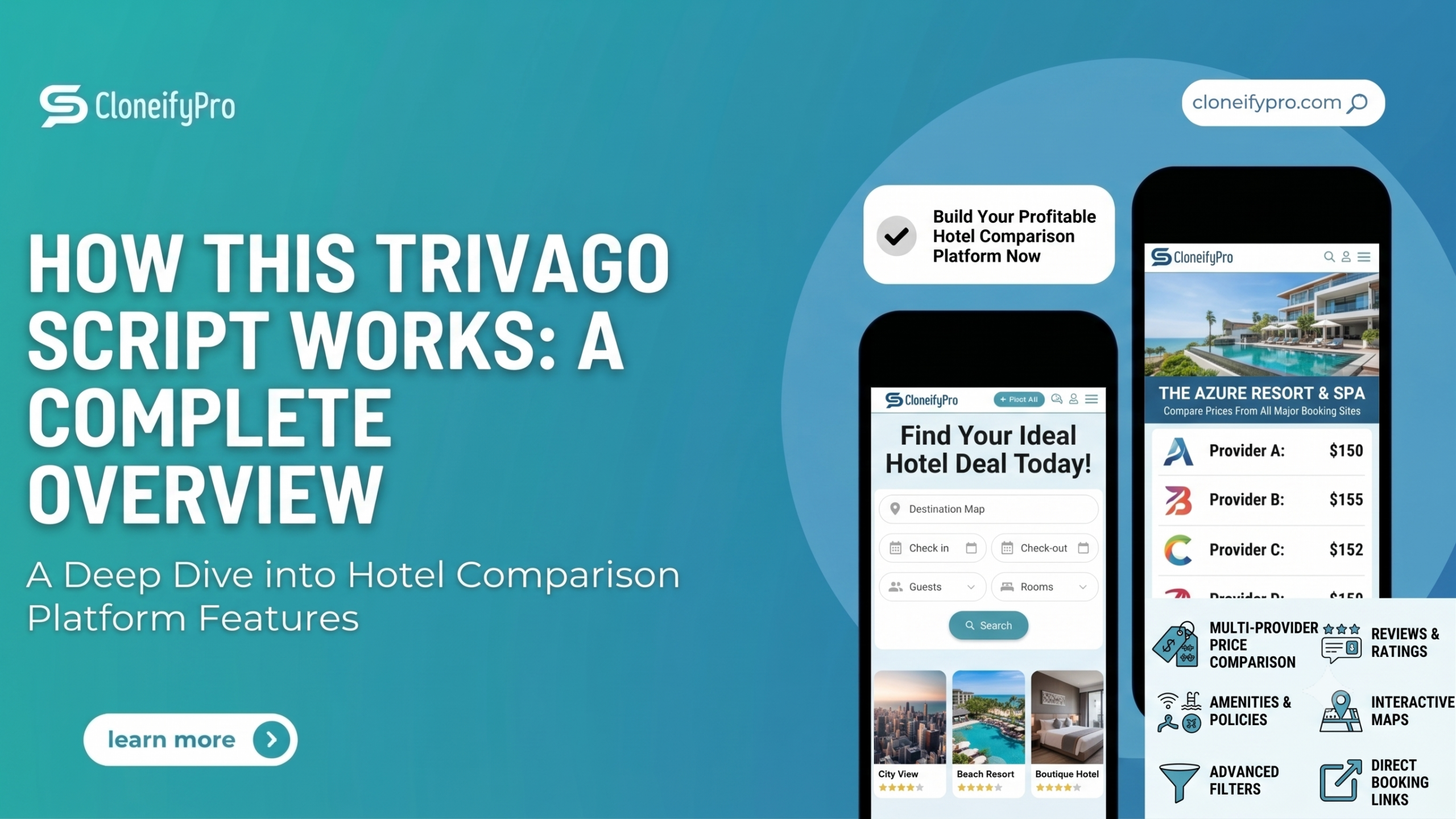
A typical hotel comparison script can connect travelers with multiple accommodation providers and booking platforms. Depending on the implementation, the platform can display:
The process can be understood in six basic stages.
The traveler starts by entering information such as:
The platform then uses those requirements to search its connected accommodation sources.
For example, a traveler searching for hotels in Chennai for a weekend might receive results from several booking partners rather than seeing inventory from only one supplier.
Trivago's current platform allows users to search by city, address, or point of interest and compare accommodation options from hundreds of booking sites.
This is the technology-heavy part of a hotel metasearch business.
A platform generally needs access to accommodation data through supplier APIs, affiliate feeds, direct hotel connections, channel managers, or other approved data integrations.
The system can collect information such as:
The data is then normalized so that information from different suppliers can be presented consistently.
This is what makes a metasearch platform different from a simple hotel directory.
The same hotel may appear across several booking providers.
Without a matching system, the platform could display the same property multiple times.
A hotel comparison script therefore needs a property-matching and data-normalization layer.
For example:
Hotel ABC
Rather than treating these as three separate hotels, the system can identify them as offers for the same property.
The user can then compare the available booking options.
Showing thousands of hotels is not enough.
Users need relevant results.
A sophisticated hotel metasearch platform can rank properties using factors such as:
Trivago says its recommendation algorithm considers factors including search criteria, price, general attractiveness, rate accuracy, and compensation received from booking sites when users click offers.
This is an important lesson for businesses building their own platform: search ranking should be useful and transparent rather than simply becoming a list of the cheapest hotels.
Once results are generated, travelers can use filters and sorting tools to narrow down their choices.
Common filters include:
Trivago's platform currently supports filters and map-based hotel discovery, while its app also allows users to compare hotels and view reviews collected from multiple booking sites.
A good Trivago-style script should therefore focus heavily on search experience and comparison UX.
This is one of the most important characteristics of the metasearch model.
The comparison platform does not necessarily need to process the entire hotel booking itself.
In the traditional Trivago model, a traveler selects an offer and is transferred to the booking site providing that offer. The booking and payment are then handled by that provider.
This creates a business flow like:
Traveler ? Hotel Search Platform ? Booking Provider ? Hotel
Depending on the business model and integrations, a platform can also support more direct booking experiences.
Trivago explains that certain services, such as Book & Go, can facilitate the reservation process with selected partners and generate a fixed percentage fee from qualifying bookings.
A hotel metasearch business can use several monetization strategies.
This is one of the clearest models for a comparison platform.
A booking partner pays the platform when a traveler clicks a particular hotel offer.
Trivago explicitly states that booking sites pay it a fee when users click on their specific deals.
For a startup, CPC monetization can create revenue without requiring the platform to handle every booking transaction.
Another option is earning a percentage when a user completes a booking.
This requires appropriate partner agreements and tracking.
The basic model is:
Hotel booking value × agreed commission = platform revenue
For example, if a partner agreement provides a 4% commission on a ?10,000 booking, the platform would generate ?400 in gross commission revenue.
The actual commercial terms vary by partner and market.
Travel businesses can also monetize traffic through:
However, sponsored placements should be clearly identified so users understand why a result is being highlighted.
Once the platform has a large audience, additional services could include:
The most appropriate revenue mix depends on the platform's target market.
A competitive hotel comparison platform should provide separate functionality for travelers, suppliers, and administrators.
The traveler-facing application can include:
Depending on the business model, suppliers may need:
The administrator can require:
The biggest technical challenge is usually not the search box. It is obtaining and maintaining accurate accommodation data.
A hotel metasearch platform may need integrations with multiple sources.
These integrations can provide:
Hotel inventory ? Room availability ? Rates ? Restrictions ? Booking information
Data synchronization also needs to account for constantly changing prices and availability.
Trivago notes that rates and availability supplied by booking sites can change frequently and that price discrepancies can sometimes occur between its results and the booking provider.
This is why businesses should prioritize reliable supplier integrations and data-quality monitoring.
AI can make a hotel comparison platform considerably more useful.
Instead of simply displaying thousands of results, an AI-powered system could help travelers discover options based on natural-language preferences.
For example:
"Find a family-friendly hotel in Goa under ?8,000 with breakfast, a swimming pool, and good beach access."
The platform could convert that request into structured search parameters.
Other potential AI features include:
AI should support the user's decision-making rather than hide important information behind an opaque recommendation.
Developing a hotel metasearch platform from zero can involve considerable work across:
A ready-made clone solution can provide a starting architecture that can then be customized.
For example, CloneifyPro's travel and marketplace solutions can be positioned as a foundation for businesses that want to develop a branded travel platform rather than building every basic component from the ground up.
The important point is that a clone should not simply copy another company's branding, proprietary content, or protected design. The objective is to reproduce the business concept and core functionality with your own branding, UX, integrations, and value proposition.
A practical launch strategy can look like this:
Do not try to compete globally on day one.
Consider focusing on:
Identify reliable hotel and booking partners and establish the necessary API or affiliate relationships.
Start with:
Once sufficient user behavior data is available, introduce smarter recommendations, alerts, and AI-assisted search.
Add CPC, booking commissions, sponsored listings, memberships, and complementary travel services where commercially and legally appropriate.
These two concepts are often confused.
A hotel booking platform typically lets users search and book directly through the platform.
A hotel metasearch platform primarily compares offers from different booking providers and directs users to the appropriate supplier.
Trivago describes itself as a metasearch engine, while an OTA is a marketplace where consumers can research and book travel products directly.
This difference affects:
Therefore, entrepreneurs should decide which model they want before beginning development.
A Trivago-style platform is fundamentally a hotel metasearch business: it brings accommodation offers from multiple sources into one convenient search experience and helps travelers compare their options.
The most important components are not simply the website design. A successful platform needs reliable supplier integrations, accurate hotel matching, fast search, useful filters, transparent ranking, strong mobile UX, effective monetization, and continuous data-quality management.
For entrepreneurs, a ready-made solution such as a Trivago clone script from CloneifyPro can provide a starting point for building a branded hotel comparison platform. The software should then be customized around a specific market, supplier network, revenue model, and customer experience.
The opportunity is especially interesting when the platform solves a specific travel problem rather than attempting to become another generic hotel search website.
Start with a focused market, build trustworthy supplier relationships, make comparison genuinely useful, and use technology—including AI—to help travelers make faster and better accommodation decisions.
A Trivago clone script is a ready-made or customizable software solution for creating a hotel metasearch platform that compares accommodation offers from multiple suppliers.
It collects accommodation information from connected booking partners or hotel suppliers, organizes and compares the offers, displays them to travelers, and can redirect users to the selected booking provider.
Trivago states that booking sites can pay it fees when users click their offers. Certain booking services can also use booking-based fees.