What if you could launch your own vacation rental marketplace without building every feature from scratch? Imagine a platform where...



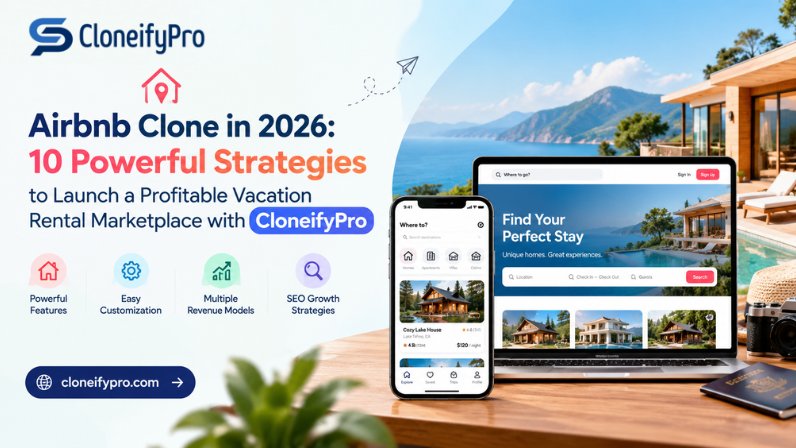
What if you could launch your own vacation rental marketplace without building every feature from scratch? Imagine a platform where property owners list apartments, travelers discover unique stays, and your business earns revenue from every successful booking. That is the opportunity behind an Airbnb clone.
As travelers increasingly seek flexible accommodations, unique experiences, and convenient digital booking options, entrepreneurs have an opportunity to build specialized rental marketplaces. However, success requires more than copying a popular platform. You need a scalable business model, an intuitive user experience, secure payments, effective marketing, and a clear strategy for attracting both hosts and guests.
This is where CloneifyPro can help aspiring marketplace entrepreneurs explore a practical approach to launching an Airbnb-like platform. Instead of starting with a completely custom development project, businesses can consider a clone-based solution to accelerate their entry into the vacation rental market.
In this comprehensive guide, you will discover what an Airbnb clone is, how it works, which features matter most, how to monetize your platform, and how to market it effectively. You will also learn the common mistakes to avoid and the steps to consider before launching your marketplace.
An Airbnb clone is a vacation rental marketplace application inspired by the core functionality of Airbnb. It connects property owners, hosts, property managers, and travelers through a digital platform where users can discover accommodations, check availability, make reservations, and manage bookings.
Although the concept takes inspiration from an established business model, your platform should have its own brand identity, user experience, and competitive positioning.
For example, imagine an entrepreneur launching a marketplace focused exclusively on eco-friendly holiday homes in South India. Property owners could publish listings, guests could filter properties by location and amenities, and the platform could collect a commission on confirmed bookings.
This focused approach offers a clearer market position than trying to compete with every accommodation provider worldwide from day one.
A typical Airbnb clone includes three main interfaces:
A successful Airbnb-like platform brings these functions together in a secure, convenient, and reliable marketplace.
The vacation rental industry offers several potential business opportunities, particularly for entrepreneurs who identify underserved customer segments.
Travelers have different needs. Some want affordable family accommodation, while others seek luxury villas, pet-friendly properties, long-term stays, or remote-work destinations. A specialized marketplace can address these needs more effectively than a general-purpose platform.
Consider these four opportunities.
Instead of targeting every traveler, focus on a specific audience. Examples include business travelers, digital nomads, adventure tourists, families, or luxury vacationers.
A niche strategy can make marketing more relevant and help your platform build trust within a defined community.
A rental marketplace can generate income through booking commissions, host subscriptions, premium listings, promotional placements, and optional service fees.
This flexibility allows you to test different revenue models as your business grows.
A marketplace focused on a particular city, region, or country can offer localized payment options, relevant property categories, regional languages, and destination-specific recommendations.
For instance, a platform specializing in homestays across Tamil Nadu could highlight heritage properties, rural experiences, and accommodations near popular tourist destinations.
A well-designed marketplace can expand into additional cities, property categories, and customer segments. Nevertheless, growth depends on operational capacity, customer acquisition, local regulations, and the quality of the booking experience.
The key insight: A promising Airbnb clone does not need to serve everyone. It needs to solve a valuable accommodation problem for a clearly defined audience.
Features influence user satisfaction, booking conversions, operational efficiency, and customer retention. Therefore, prioritize the functions that help guests book confidently and hosts manage their properties efficiently.
Provide a straightforward registration process using email, phone verification, or supported third-party sign-in methods.
Include account recovery, secure session management, and appropriate privacy controls. Where necessary, implement identity verification to strengthen trust.
Hosts should be able to add property descriptions, photographs, nightly rates, amenities, house rules, occupancy limits, and cancellation policies.
An effective listing editor should make it easy to update information without requiring technical assistance.
Search functionality is one of the most important parts of a rental marketplace.
Allow users to filter results by:
A map-based search can also help travelers understand the property’s location before making a reservation.
Accurate calendars reduce the risk of double bookings and improve the guest experience.
Your platform should support availability management, booking confirmations, reservation status updates, cancellation workflows, and notifications.
For businesses managing multiple booking channels, calendar synchronization can be especially valuable.
Integrate a suitable payment gateway that supports your target market.
Depending on your business model and payment provider, you may need to support refunds, transaction records, platform commissions, and host payouts.
Payment processing and marketplace payouts require careful planning. Confirm that your provider supports your business model, target countries, and applicable compliance requirements.
Verified booking reviews help travelers assess properties and make informed decisions.
Allow eligible guests to rate their stays and provide feedback. Establish moderation policies to address fraudulent reviews, harassment, and inappropriate content.
In-platform messaging allows guests and hosts to discuss check-in instructions, property details, and special requests.
Email, SMS, or push notifications can communicate booking confirmations, payment updates, reminders, and cancellations.
Administrators need tools to manage users, approve listings where appropriate, monitor transactions, investigate disputes, and review marketplace performance.
Useful analytics include booking conversion rates, average booking value, cancellation rates, repeat bookings, and customer acquisition costs.
Practical recommendation: Prioritize reliable search, listings, booking management, payments, and administration before investing heavily in advanced features.
Launching a marketplace becomes more manageable when you break the process into clear business and technical stages.
CloneifyPro can be considered as part of a clone-based development approach. Before selecting any solution, review its current feature set, customization options, deployment process, pricing, integrations, and ongoing support. Verify which capabilities are included rather than assuming every marketplace feature comes standard.
Determine who will use the platform and why they would choose it over existing alternatives.
Identify your target market, primary property categories, geographic coverage, and competitive advantage.
For example, a platform for monthly furnished rentals may need flexible booking periods and recurring payment options, whereas a holiday villa marketplace may prioritize availability calendars and group accommodation filters.
Analyze competing platforms, customer reviews, property owner requirements, and local travel patterns.
Interview prospective hosts and travelers to identify common frustrations. These might include unclear fees, complicated booking processes, limited payment methods, or insufficient property information.
Use these findings to create a focused product roadmap.
Assess whether CloneifyPro fits your functional and commercial requirements.
Ask the provider about the following:
Request a demonstration and test the core booking journey before committing.
Build a recognizable brand using your own name, logo, colors, content, and visual design.
Configure property categories, search filters, booking rules, commission structures, and notifications to match your market.
Avoid copying Airbnb’s protected branding, proprietary content, or distinctive assets. Use the business model as inspiration while creating an original product.
Configure payment processing, email delivery, analytics, and any required verification services.
Test successful payments, failed transactions, refunds, cancellations, and payout workflows. Also, verify that sensitive information receives appropriate protection.
Run end-to-end tests covering guest registration, property publication, date selection, booking confirmation, payment, cancellation, and review submission.
Test the experience across common mobile devices, browsers, and network conditions.
Finally, invite a small group of hosts and travelers to participate in a controlled pilot. Their feedback can reveal problems that internal testing may overlook.
A rental marketplace can use several monetization strategies, although the right combination depends on the target market and customer expectations.
Charge a percentage of eligible bookings. This model aligns revenue with marketplace activity and can reduce the initial cost of joining.
For example, suppose your platform processes 500 bookings per month with an average booking value of ₹8,000. If the platform earns a 10% commission on the full booking value, monthly gross commission revenue would be ₹4,00,000.
This is an illustrative calculation, not a revenue forecast. Actual earnings depend on booking volume, commission rules, refunds, taxes, payment fees, and other costs.
Offer optional monthly or annual subscriptions for hosts who need advanced reporting, additional listing-management tools, or enhanced support.
Ensure the paid benefits provide measurable value.
Allow eligible hosts to pay for additional visibility in designated search placements or promotional collections.
Clearly label sponsored placements and maintain relevant search results to preserve user trust.
As the business develops, you could explore partnerships for cleaning, property photography, maintenance, travel experiences, or property management.
Introduce these services only when they address genuine customer needs and comply with relevant regulations.
Important: Revenue is not the same as profit. Budget for marketing, hosting, customer support, payment processing, refunds, insurance where appropriate, legal advice, and ongoing development.
Search engine optimization can help your marketplace attract travelers who are actively searching for accommodation.
However, SEO requires consistent technical maintenance, useful content, and a credible supply of quality listings. Publishing hundreds of thin property pages will not automatically improve rankings.
Research relevant terms such as:
Use these terms naturally in page titles, headings, descriptions, and helpful explanatory content.
Create separate pages for distinct audiences, such as hosts, property managers, and travelers.
Develop high-quality destination pages that provide genuine value.
For example, a page about holiday rentals in a specific city could include neighborhood information, accommodation types, local travel tips, and available properties.
Avoid creating near-identical pages for hundreds of locations without meaningful differences.
Optimize loading speed, mobile usability, internal linking, crawlability, and indexation.
Use descriptive URLs, canonical tags where appropriate, XML sitemaps, and structured data that accurately reflects visible page content.
For property pages, relevant structured data may help search engines interpret the information, but it does not guarantee rich results or higher rankings.
Build a content strategy around questions your audience actually asks.
Potential topics include host onboarding, vacation rental pricing, property photography, guest safety, cancellation policies, and rental business management.
Link these articles to relevant platform pages to help readers discover your services.
Earn relevant backlinks through partnerships, original research, industry contributions, and useful resources.
Collect genuine customer reviews and publish transparent information about platform fees, customer support, and booking policies.
SEO takeaway: Focus on user intent, trustworthy content, and technical quality instead of keyword repetition or shortcuts.
An Airbnb clone script is a software foundation designed to reproduce core vacation rental marketplace workflows, such as property listings, searches, bookings, and payments. Available features and customization options vary by provider.
There is no universal price. Costs depend on licensing, customization, integrations, hosting, security, maintenance, and the complexity of the booking system.
A clone-based solution may reduce the amount of custom development required, but businesses should compare the total cost of ownership rather than focusing only on the initial purchase price.
The timeline depends on product readiness, customization, integrations, testing, and operational preparation. A relatively straightforward implementation may launch faster than a marketplace requiring extensive custom features or complex regional payment workflows.
Ask the provider for a realistic delivery schedule based on your requirements.
It can be, but profitability is not guaranteed. Success depends on demand, host acquisition, booking frequency, commission levels, operating expenses, competition, and customer retention.
Start with a clearly defined market and validate demand before expanding.
Customization depends on the software’s architecture, licensing terms, and available development options. Evaluate branding flexibility, workflows, payment integrations, search functionality, and future scalability before choosing a solution.
Developing a competing vacation rental marketplace is not inherently unlawful. However, businesses must respect intellectual property, trademarks, privacy requirements, consumer protection rules, payment regulations, tax obligations, and local accommodation laws.
Seek qualified legal advice for the jurisdictions in which you plan to operate.
CloneifyPro is a potential starting point for businesses exploring a clone-based marketplace strategy. Its suitability depends on the features, support, customization, pricing, and deployment options it currently offers. Verify these details directly before making a purchasing decision.
Even a feature-rich marketplace can struggle if its business fundamentals are weak.
First, avoid launching without enough quality listings. Travelers need meaningful choices before they can develop a habit of using your platform. Recruit and onboard suitable hosts before investing heavily in broad consumer marketing.
Second, do not overlook trust and safety. Establish listing standards, clear cancellation policies, appropriate verification procedures, and a process for handling disputes.
Third, resist the temptation to launch every possible feature at once. A focused minimum viable product makes it easier to test assumptions, gather feedback, and allocate resources effectively.
Fourth, do not underestimate customer acquisition costs. Track the cost of acquiring hosts and guests separately because each group may require a different marketing approach.
Finally, avoid expanding into multiple markets before understanding the operational requirements of your first market.
A structured launch plan helps turn the idea into measurable actions. The following schedule is an illustrative starting point, not a guaranteed delivery timeline.
Days 1–7: Research and validation
Define your niche, analyze competitors, interview potential users, and document your essential features.
Days 8–14: Product evaluation and configuration
Evaluate CloneifyPro and alternative solutions, compare total costs, and configure your brand, listings, and booking workflows.
Days 15–21: Testing and host acquisition
Test critical booking scenarios, recruit initial property owners, review payment settings, and prepare customer support procedures.
Days 22–30: Pilot launch and optimization
Invite a limited group of travelers, monitor bookings and user feedback, resolve problems, and refine the onboarding process.
If customization, integrations, or compliance requirements demand more time, extend the schedule rather than compromising quality.
An Airbnb clone can provide a foundation for entrepreneurs who want to enter the vacation rental marketplace industry. Nevertheless, long-term success depends on more than replicating familiar features.
You need a clearly defined audience, reliable booking workflows, secure payments, quality property listings, effective search visibility, and a sustainable revenue model.
A clone-based solution may help simplify the initial development process, provided it meets your technical and business requirements. CloneifyPro is worth evaluating as part of that decision, but confirm its current capabilities, commercial terms, and support arrangements before investing.
Start with one market, solve a real accommodation problem, recruit quality hosts, and deliver a trustworthy booking experience. Then use customer feedback and performance data to guide your next steps.
The opportunity is not simply to create another Airbnb-like website. It is to build a differentiated marketplace that makes finding and booking the right accommodation easier for a specific group of travelers.