In the ever-evolving world of artificial intelligence, two terms often spark curiosity—and confusion—among businesses and tech enthusiasts alike: A...



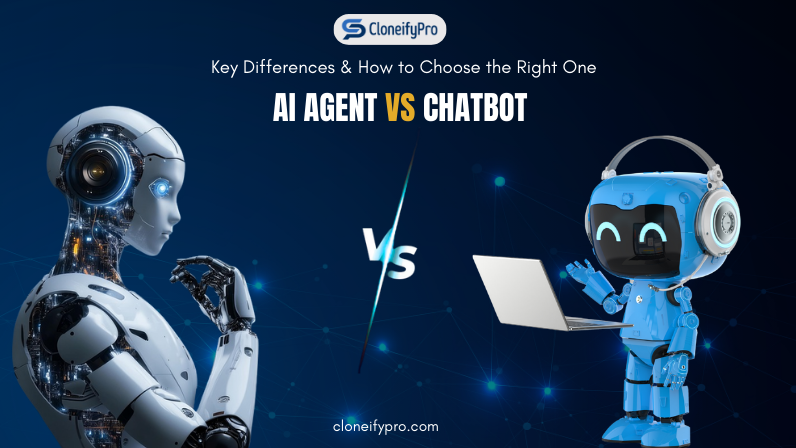
In the ever-evolving world of artificial intelligence, two terms often spark curiosity—and confusion—among businesses and tech enthusiasts alike: AI Agents and Chatbots. While both are designed to interact with users and perform automated tasks, they are not the same thing. Knowing their differences can help you decide which one fits your business goals best.
Whether you’re a startup looking to enhance customer support or a large enterprise aiming to automate complex workflows, understanding these two technologies is key. As a chatbot development company, Cloneifypro helps businesses integrate the right AI-powered solutions for maximum efficiency and user satisfaction.
An AI Agent is an autonomous program that perceives its environment, processes information, and takes action to achieve specific goals—often without constant human supervision. Unlike simple bots that only follow pre-defined rules, AI Agents can learn, adapt, and make independent decisions based on data and context.
Key Characteristics of AI Agents:
Example Use Cases:
A Chatbot is a software application designed to simulate human conversation via text or voice. It primarily follows pre-programmed scripts or uses AI-based natural language processing (NLP) to understand user input and respond accordingly.
Types of Chatbots:
Key Characteristics of Chatbots:
Example Use Cases:
While they overlap in certain areas, AI Agents and Chatbots differ in scope, complexity, and autonomy.
| Feature | AI Agent | Chatbot |
|---|---|---|
| Primary Function | Autonomous problem-solving & decision-making | Conversational user interaction |
| Learning Ability | High – learns from data and adapts | Limited – may use NLP but not fully autonomous |
| Complexity | Handles multi-step, complex tasks | Usually focuses on simple, direct tasks |
| Context Awareness | Understands long-term context and history | May remember limited recent context |
| Integration | Works across multiple systems and environments | Often integrated into a single platform |
| User Interaction | May or may not directly interact with users | Primarily user-facing |
| Examples | Automated trading system, self-driving cars | Customer service bot, booking bot |
Chatbots typically work based on predefined rules or simple AI models. They identify keywords or user inputs and respond according to programmed scripts.
For example:
User: “What are your business hours?”
Chatbot: “Our business hours are 9 AM to 6 PM.”
The chatbot responds based on existing programmed information.
Some modern chatbots also use NLP to understand user intent better, but they still have limitations in handling complex situations.
AI agents go beyond scripted communication. They analyze user behavior, understand intent, access real-time information, and perform actions.
For example:
User: “Book a meeting with the sales team next Friday.”
AI Agent:
This level of automation makes AI agents far more powerful than standard chatbots.
Chatbots reduce the need for large customer support teams by handling repetitive queries automatically.
Businesses can provide continuous customer assistance even outside working hours.
Customers receive instant replies without waiting for human agents.
Basic chatbots are relatively simple and quick to deploy.
Chatbots can collect customer information and qualify leads efficiently.
AI agents automate complex business processes beyond simple conversations.
They deliver personalized and human-like interactions.
Businesses save time by automating repetitive and multi-step tasks.
AI agents analyze customer data and provide actionable insights.
AI agents can manage large-scale operations efficiently without compromising performance.
Here’s a step-by-step approach to decide between an AI Agent and a Chatbot:
You should consider an AI Agent if:
Example:
A logistics company uses an AI Agent to plan delivery routes in real-time based on traffic data, weather conditions, and fuel costs.
You should choose a Chatbot if:
Example:
An online clothing store uses a chatbot to recommend outfits, track orders, and answer return policy questions.
AI Agent Example – Tesla Autopilot:
Uses computer vision, real-time sensors, and machine learning to make driving decisions without human input.
Chatbot Example – Duolingo Bot:
Engages learners in conversation to practice language skills and answer questions instantly.
Sometimes, the best solution is to combine both. For example, a retail business could use:
This hybrid approach delivers both customer engagement and intelligent automation.
A chatbot development company like Cloneifypro doesn’t just build conversation bots—it also helps you integrate advanced AI Agents when needed. By understanding your business requirements, we can create tailored solutions that:
At Cloneifypro, we specialize in delivering:
Whether you need a simple customer support chatbot or a full-fledged AI agent to manage enterprise operations, we ensure your solution is:
AI Agents and Chatbots each have unique strengths. If you need direct interaction and quick responses, go for a chatbot. If you require complex automation and independent decision-making, an AI Agent is the way to go. In some cases, using both can give you the best of both worlds.
Partnering with the right chatbot development company ensures you don’t just get a tool—you get a strategic advantage.
Ready to transform your business with AI-powered solutions?
At Cloneifypro, we build intelligent, scalable, and user-friendly chatbots and AI agents tailored to your business goals. Let’s take your automation to the next level—starting today.
An AI agent is more advanced, capable of learning, understanding context, and making decisions, while a chatbot follows pre-defined scripts or rules to answer basic queries.
If you handle simple, repetitive queries, a chatbot is ideal. For complex, personalized interactions, an AI agent is the better choice.
A chatbot development company designs, builds, and integrates custom bots or AI agents that fit your business goals, ensuring smooth workflows and better customer engagement.
Chatbots are easier and faster to implement. AI Agents require more customization. Cloneifypro tailors timelines based on your business goals.
Yes, AI agents usually cost more to develop because they require advanced AI models, integrations, and ongoing training, unlike simple chatbots.
Basic chatbots cannot learn on their own. AI-powered chatbots can, but they function more like simplified AI agents.
Industries like finance, healthcare, eCommerce, and travel benefit most due to their need for personalization, real-time decision-making, and complex task handling.
Cloneifypro designs, develops, and integrates AI Agents and Chatbots tailored to your goals, ensuring better automation, engagement, and ROI.